
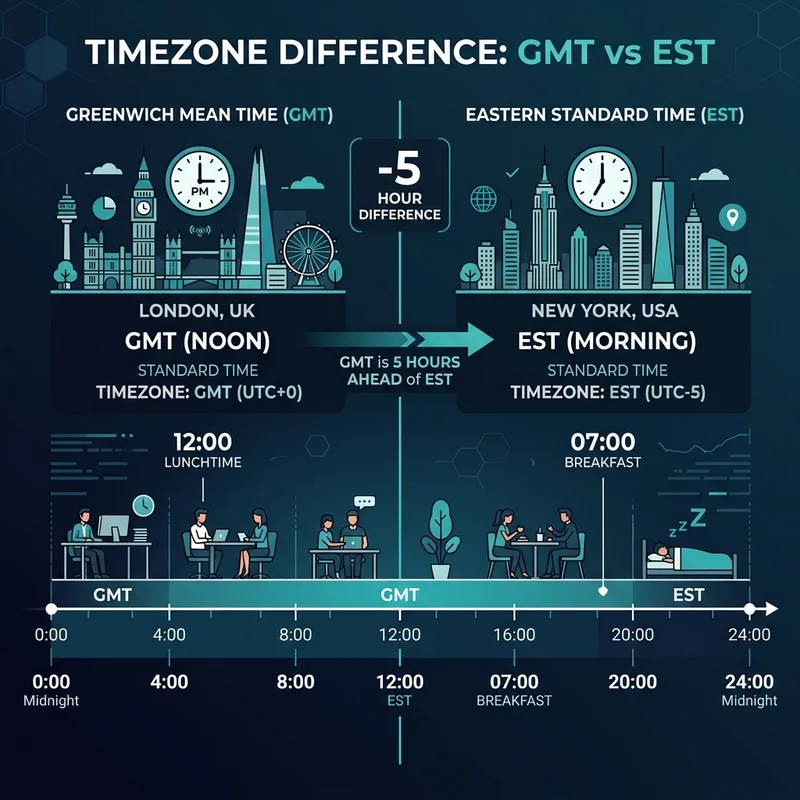
Greenwich Mean Time isn't just a British curiosity. It's the zero point nearly every other time zone on the planet defines itself against — including Eastern Standard Time, five hours behind it in winter and four in summer. For anyone working across borders, that relationship is the quiet backbone of every scheduled call, invoice deadline, and market open.
It shows up constantly and rarely gets a second thought — until a client in New York, a contractor in Karachi, and a supplier in London all need to agree on when "Tuesday" actually starts. That's the exact moment a GMT to EST Converter earns its place in the workflow: instead of triangulating three local clocks by hand, one shared reference point resolves all of them at once.
This matters more for international freelancers and distributed businesses than almost anyone else, because their working day rarely fits inside one country's business hours to begin with.
Why Greenwich became the world's zero point
In 1884, the International Meridian Conference chose the meridian running through the Royal Observatory in Greenwich as the world's prime meridian — the 0° longitude line every other time zone is measured from, east or west. Eastern Standard Time didn't emerge in isolation; it's defined relative to that same line, at a fixed offset of five hours behind (UTC-5), shifting to four (UTC-4) during Eastern Daylight Time.
- London (GMT, UTC+0) — the reference point everything else is measured against.
- New York (EST/EDT, UTC-5/-4) — five or four hours behind Greenwich, depending on the season.
- Manila, Karachi, Lagos and dozens of other freelance and outsourcing hubs — each converting through GMT/UTC as the common intermediate step when coordinating with US clients.
Working with clients or teammates in a different country than your own? Confirm the current Eastern Time offset before you commit to a schedule.
Open the GMT to EST ConverterFreelancing and invoicing across the offset
For an independent contractor working with US East Coast clients from almost anywhere else in the world, GMT-to-EST is rarely the only conversion involved — it's usually the reference step. A freelancer in South Asia converts their own local time to GMT/UTC mentally or via a tool, and from there to Eastern Time, because that's the shared vocabulary most international invoicing platforms, project trackers, and calendar tools default to.
Deadlines stated as "5 PM EST" are unambiguous to the client but require a second conversion for almost everyone else reading them. Getting that second conversion wrong by even an hour, especially around a DST transition, is a common and avoidable source of missed submissions.
A practical habit: when a deadline or meeting is stated only in EST, convert it to your own local time immediately and note it on your calendar in that form — rather than re-deriving the offset each time the date approaches.
Markets that never stop watching the offset
Global finance runs on this same relationship. London and New York trading hours overlap for a narrow window each business day, and that overlap — roughly 8:00 AM to 12:00 PM Eastern, 1:00 PM to 5:00 PM GMT — is when the deepest liquidity in currency and equity markets tends to appear. Traders, analysts, and firms operating across both centers track the GMT/EST relationship constantly, because a missed hour there isn't a scheduling inconvenience — it's a missed window.

Coordinating across more than two regions
Once a third or fourth region enters the picture — a design team in Eastern Europe, a support desk in South Asia, a client base on the US East Coast — GMT/UTC becomes the practical common denominator rather than any single local zone. Teams that standardize internal documentation, meeting invites, and deployment logs in GMT/UTC give every region the same starting point to convert from, instead of asking each person to reason about everyone else's local time individually.
This is as true for scheduling as it is for the systems underneath it. If your team also stores or reasons about timestamps in backend systems, our engineering guide on timestamp handling covers the same UTC-first principle from the technical side — cron jobs, logs, and API design.
The takeaway
Greenwich Mean Time isn't a relic of British maritime history — it's still the working reference point that Eastern Time, and most other zones, are defined against. For anyone earning, trading, or coordinating across borders, treating GMT/UTC as the shared intermediate step, rather than trying to convert directly between two arbitrary local times, removes most of the ambiguity from international scheduling.
Coordinating a deadline or call across time zones and want a second opinion? Get in touch with the GMT to EST Converter team.